EN 361 Full Body Harness: How to Choose, Wear & Inspect
EN 361 full body harness guide: A-marked attachment points, fall arrest system parts (EN 355, EN 362, EN 795), fall clearance, sizing, and pre-use inspection.

Avenix Team
· 8 min read
 Ilustrasi
Summary
EN 361 is the European standard for full body harnesses, the body-holding device that stops a worker's fall and spreads the force across the thighs, pelvis, chest and shoulders. A harness is only one part of a fall arrest system: it must be connected to a strong anchor through an energy-absorbing lanyard or fall arrester, with enough fall clearance, and inspected before every use.
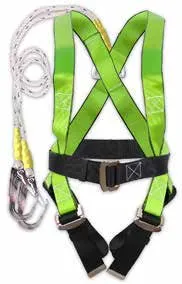
An EN 361 full body harness is the fall arrest harness that spreads the impact force across the thighs, pelvis, chest and shoulders when a worker falls. A harness is only one component of a fall arrest system. To truly protect, it must be connected to a strong anchor through an energy-absorbing lanyard or fall arrester, fitted properly, used with enough fall clearance, and checked before every use.
This guide is written for HSE teams, site supervisors and procurement staff on construction projects, in shipyards and at industrial facilities.
What is EN 361?
EN 361 is the European standard that sets the requirements, test methods, marking and instructions for full body harnesses used in personal fall arrest systems. It covers the strength of straps and buckles, dynamic drop tests with a dummy load, and the body position after a fall is arrested.
In Indonesia, work at height is regulated by Minister of Manpower Regulation No. 9 of 2016 on Occupational Safety and Health for Work at Height. It requires planning, work procedures, competent workers, personal fall protection equipment and a rescue plan. PPE must meet the applicable standards, and EN 361 is one of the most common references on projects and in shipyards.
A harness is only one part of the system
A fall arrest system under EN 363 is made up of several connected components, each with its own standard:
| Component | Function | Reference standard |
|---|---|---|
| Anchor | Strong point the system is attached to | EN 795 |
| Connector / karabiner | Links components, with a locking gate | EN 362 |
| Lanyard | Connects the harness to the anchor | EN 354 |
| Energy absorber | Reduces the impact force when a fall is arrested | EN 355 |
| Retractable fall arrester | Self-retracting line that locks during a fall | EN 360 |
| Full body harness | Holds and supports the body | EN 361 |
If one component fails, the whole system fails. Choose compatible components and follow the manufacturer’s instructions on permitted combinations.
Harness, work positioning belt and sit harness
- Full body harness (EN 361) is the only body-holding device allowed for fall arrest.
- Work positioning belt (EN 358) only supports a worker in a work position or restrains them from reaching an edge. It must not be used for fall arrest.
- Sit harness (EN 813) is for rope access and seated positions, usually worn together with a full body harness.
Many modern harnesses combine EN 361 with EN 358, giving chest and back attachment points plus a belt with side rings for work positioning.
Reading attachment points and markings
A-marked attachment points
Fall arrest attachment points are marked with the letter A:
- Dorsal (back): the most common point for lanyards and retractable fall arresters.
- Sternal (chest): useful on ladders with vertical guided systems or when working facing a structure.
- A/2: two points marked A/2, such as two chest loops, must be connected together with one connector. Neither may be used on its own.
Side rings on the waist (usually on an EN 358 belt) are for work positioning only, not fall arrest.
Mandatory label
A proper harness label shows the manufacturer, model, standard number (EN 361 and any others), size, serial or batch number, year of manufacture, and a pictogram telling the user to read the instructions. A harness without a legible label should not be used.
How to choose a full body harness
1. Match the type of work
| Work | Recommended features |
|---|---|
| Scaffolding, roofs, steel structures | Dorsal + sternal points, twin lanyard with energy absorber |
| Positioning on poles or walls | Combined EN 361 + EN 358 with side rings |
| Vertical ladders with rail or rope guides | Sternal point compatible with guided type fall arresters |
| Ship hulls, tight spaces | Lightweight harness, quick buckles, easy-to-reach dorsal ring for rescue |
| Welding | Webbing or covers resistant to weld spatter, per manufacturer’s instructions |
2. Correct fit
A harness that is too loose can let the worker slip out or cause a severe jolt to the groin when a fall is arrested. For example, the Delta Plus HAR23 and HAR42EL come in SM/MD/LG and XL/2X size ranges. When fitting:
- Leg and chest straps can be tightened until about two fingers fit between strap and body.
- The dorsal ring sits between the shoulder blades.
- All loose strap ends are tucked into the keepers.
3. Comfort for long shifts
Shoulder and leg padding, automatic buckles and the number of adjustment points affect whether workers keep the harness on correctly for the whole shift. Harnesses such as the GoSave FBH Eco have wide webbing, padding and 3 adjustment points. The Delta Plus Elara390 and Elara350 series have 2 fall arrest points (back and chest) and a restraint point on the belt.
4. Choose a complete kit
For new teams, a complete kit reduces the risk of mismatched components. For example, the Delta Plus Elara140 kit contains a HAR12 harness, a MINIBLOC AN102 retractable fall arrester and an AM002 karabiner in one bag.
Calculate fall clearance
Fall clearance is the minimum distance from the anchor to the floor or nearest obstruction so that the worker does not hit anything before the fall is arrested. For a 2 m lanyard with an energy absorber, a rough estimate:
| Element | Estimate |
|---|---|
| Lanyard length | 2.0 m |
| Maximum energy absorber extension (EN 355) | up to 1.75 m |
| Dorsal point to soles of the feet | about 1.5 m |
| Safety margin | about 1.0 m |
| Total below the anchor | about 6 m |
If clearance is not enough, use a shorter lanyard, move the anchor higher, or use a retractable fall arrester that locks within a shorter distance. Always use the figures in the manufacturer’s instructions.
Ideally the anchor is above the worker’s head. An anchor at foot level increases the fall distance and impact force, and many lanyards are not designed for it.
A strong anchor
The anchor must hold the fall forces with a large margin. Common references:
- EN 795 for anchor devices.
- OSHA 1926.502 in the United States requires anchors to support 5,000 lbf (about 22.2 kN) per attached worker, or to be designed by a qualified person with a safety factor of at least two.
Never clip a lanyard to small pipes, temporary guardrails, light rails or structures of unknown strength.
Inspection before every use
The user checks the harness every time before wearing it. Quick checklist:
- Label is legible, including standard, size and year of manufacture.
- Webbing free of tears, cuts, fraying, burns or weld spatter marks, chemical stains and heat discoloration.
- Stitching intact, with no broken or pulled threads.
- Buckles and D-rings not cracked, corroded, bent or sharp, and locking mechanisms work.
- Fall indicator on the harness or lanyard has not been triggered.
- Lanyard and energy absorber intact, absorber pack not torn.
- Karabiners close and lock automatically and fully.
If in doubt, withdraw the harness from use and tag it “do not use”.
Periodic examination
EN 365 requires periodic examination by a competent person at least every 12 months, or more often according to the manufacturer’s instructions and working conditions. Record every examination on a card or inspection log per serial number.
Replace immediately if
- The harness has arrested a fall.
- Damage is found on webbing, stitching or metal parts.
- It has passed the manufacturer’s service life.
- The label is missing or illegible.
Storage and care
- Store in a dry, shaded place, away from direct sunlight, heat sources and chemicals.
- Hang the harness so it is not crushed by sharp or heavy objects.
- Clean with water and mild soap, then let it dry naturally. Do not use solvents, bleach or heated dryers.
- Never modify the harness, for example by adding rings or altering stitching.
Rescue plan
A worker hanging in a harness after an arrested fall must be rescued quickly. Hanging too long can restrict blood flow (suspension trauma). Regulation No. 9 of 2016 requires a rescue plan for work at height. Prepare equipment, trained personnel and a procedure that can be carried out within minutes, not one that waits for outside help.
Conclusion
Choose a full body harness labelled EN 361 that suits the work and the worker’s size, then complete it with a compatible lanyard, energy absorber, connectors and anchor. Calculate fall clearance, check the harness before every use, have it examined periodically by a competent person, and keep a rescue plan ready.
Avenix supplies full body harnesses and fall protection equipment from Delta Plus and GoSave, including the Delta Plus HAR23 & HAR42EL, Delta Plus Elara390 & Elara350, Delta Plus Elara140 kit and GoSave FBH Eco, for projects in Batam and Bintan. Browse all options in the fall protection category, read our mandatory PPE checklist for construction and shipyards, or send worker numbers and sizes via Request a Quote.