Safety Helmets: Types, Colour Codes, EN 397 & How to Choose
Guide to site safety helmets: types and materials, helmet colour codes, EN 397, EN 50365 and ANSI Z89.1, how to wear and inspect them, and when to replace.

Avenix Team
· 9 min read
 Ilustrasi
Summary
Safety helmets for construction and industry should meet EN 397 or ANSI/ISEA Z89.1, and carry the SNI mark where available. Match material and features to the hazard: unvented for electrical work, a chin strap for work at height, and accessory slots for face shields or earmuffs. Replace a helmet after a heavy impact, or when the shell is cracked, chalky or past the manufacturer's service life.
The right safety helmet is chosen by the hazards in the work area, not by colour or price alone. For construction sites, factories and shipyards, choose a helmet that meets EN 397 or ANSI/ISEA Z89.1, carries the SNI mark where available, and has features that suit the job: unvented for electrical work, a chin strap for work at height, and accessory slots for face shields or earmuffs.
This guide covers helmet types and materials, the colour codes commonly used on site, how to read the standard markings, how to wear a helmet correctly and when to replace it.
What a safety helmet does
A safety helmet (hard hat) protects the head from:
- Falling objects such as bolts, tools or material dropped from scaffolding.
- Impact against structures, pipes or beams when working in tight spaces.
- Sharp objects that could penetrate the shell.
- Additional hazards depending on the helmet: electric shock, molten metal splash or extreme temperatures.
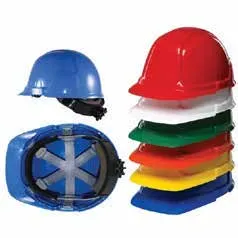
That protection comes from two parts working together: the hard shell, which spreads and resists the impact, and the suspension (harness) inside it, which keeps a gap between shell and head and absorbs impact energy. A helmet without a correctly fitted suspension does not give the protection it was designed for.
Parts of a safety helmet
| Part | Function |
|---|---|
| Shell | Resists and spreads impact and penetration |
| Suspension (cradle) | Straps inside the helmet (4 or 6 points) that keep the gap between head and shell |
| Headband | Fits around the head, adjusted by a sliding/pin-lock or ratchet system |
| Sweatband | Replaceable pad on the forehead that absorbs sweat |
| Chin strap | Keeps the helmet on when bending over, in wind or in a fall |
| Accessory slots | Mounts on the sides for earmuffs, face shields or visors |
A 6-point suspension is generally more stable and comfortable for long wear than a 4-point one. A ratchet headband is quicker to adjust with gloves on, while a sliding system is lighter and simpler.
Types and materials
By shape
- Cap style: the most common on site, with a short front peak that does not block the upward view.
- Full brim: shades the neck from sun and rain, suited to outdoor work.
- Work at height and rope access helmets: a more compact shape without a long peak, and a strong chin strap so the helmet stays on when a worker falls and is caught by the harness.
By shell material
| Material | Characteristics | Note |
|---|---|---|
| HDPE (polyethylene) | Light, economical, chemical resistant | Degrades faster under UV, watch the service life |
| ABS | Stiffer, smooth surface, good impact resistance | Common for industrial helmets |
| Polycarbonate (PC) | Strong and light | Less resistant to some chemical solvents |
| Fibreglass/composite | High heat resistance | Suits hot areas such as foundries |
The shell material is usually moulded inside the helmet as an abbreviation (for example HDPE or ABS), next to the manufacturing date.
Safety helmet colour codes
In Indonesia there is no single national regulation that assigns a helmet colour to each role. Colours follow the policy of the company or project owner, so they can differ between sites. The most common conventions:
| Colour | Typical wearer |
|---|---|
| White | Managers, engineers, supervisors |
| Yellow | General workers, equipment operators and contractors |
| Blue | Technicians, electricians or other technical staff |
| Red | Emergency response, fire teams or special roles |
| Green | Safety officers or new workers, depending on the site |
| Orange | Visitors, riggers or signallers |
Colours help people recognise roles from a distance, for example when looking for a supervisor or emergency responder. Protection still depends on the standard and condition of the helmet, not its colour. When ordering helmets for a project, match the number of each colour to the rules on site.
Standards to know
EN 397: industrial safety helmets
EN 397 is the European standard most often found on site helmets in Southeast Asia. Its mandatory tests include:
- Shock absorption: a 5 kg striker dropped from 1 m onto the crown (about 49 J); the force transmitted to the head must not exceed 5 kN. Tests are run after conditioning in heat, cold and water.
- Penetration resistance: a 3 kg pointed striker dropped from 1 m must not reach the test headform.
- Flame resistance: the shell must not keep burning after the flame is removed.
- Chin strap (if fitted): must release at 150–250 N so it cannot strangle the wearer if the helmet snags.
Optional features are marked on the label:
| Marking | Meaning |
|---|---|
| -20 °C or -30 °C | Passes tests at very low temperature |
| +150 °C | Passes tests at very high temperature |
| 440 Vac | Electrical insulation up to 440 V AC |
| LD | Resists lateral deformation |
| MM | Resists molten metal splash |
Other standards
| Standard | Scope |
|---|---|
| EN 50365 | Electrically insulating helmets for low-voltage work up to 1000 V AC |
| EN 12492 | Mountaineering helmets, often used for work at height and rope access because the chin strap is designed to keep the helmet on |
| EN 14052 | High-performance industrial helmets, including side impact and higher impact energy |
| ANSI/ISEA Z89.1 | US standard: Type I (top impact), Type II (top and lateral); Class G (2,200 V), Class E (20,000 V), Class C (no electrical protection) |
Helmets sold in Indonesia often also carry the SNI mark. Check the label and the supplier’s documents to confirm which standards are met.
How to choose by job
| Job or area | Recommendation |
|---|---|
| General construction | EN 397 or ANSI Type I, 6-point suspension, accessory slots |
| Electrical and panel work | Unvented helmet marked 440 Vac, EN 50365 or Class E |
| Work at height, scaffolding, rope access | Helmet with a strong chin strap (EN 12492 or equivalent), worn with a full body harness |
| Shipyards and confined spaces | Light helmet with chin strap, slots for earmuffs and face shield; consider the LD marking |
| Welding and cutting | Helmet that accepts a welding mask, or rated for molten metal splash (MM) |
| Hot areas, foundries | Heat-resistant material (fibreglass/composite), +150 °C or MM marking |
| Outdoor work | Full brim for shade, UV-resistant material, ventilation where there is no electrical hazard |
Other points to consider:
- Size: most helmets adjust to a head circumference of about 53–63 cm. Check that the size range on the label suits your workers.
- Comfort: heavy or hot helmets tend to get taken off. Ventilation helps in a tropical climate, but only for work without electrical hazards.
- Accessories: if workers also need hearing or face protection, choose a helmet with compatible accessory slots so earmuffs and face shields sit securely.
How to wear a safety helmet correctly
- Adjust the headband until the helmet sits snugly and does not move when you turn or bend your head.
- Keep the gap between head and shell. Do not wear a cap or anything else inside the helmet, except a liner approved by the manufacturer.
- Wear the helmet facing forward. Wear it backwards only if the manufacturer states it has passed testing for reverse wear.
- Fasten the chin strap when working at height, in wind or when bending over often.
- Do not keep items inside the helmet while wearing it.
Pre-use inspection
Check the helmet every day before use:
- Shell: no cracks, dents or holes. A dull, chalky or badly faded surface indicates UV damage.
- Suspension: straps not torn or brittle, clips firmly attached at every point.
- Headband and chin strap: adjusters work, straps not torn.
- Manufacturing date: usually moulded as a clock symbol or numbers inside the shell. Compare it with the manufacturer’s service life.
Avoid damaging the helmet by accident: do not paint it or use solvent-based stickers, do not drill the shell, and do not leave it on a hot dashboard or rear shelf of a car.
When to replace a safety helmet
Replace the helmet immediately if:
- It has taken a heavy impact, even if no damage is visible.
- The shell is cracked, dented or penetrated.
- The surface has become dull, chalky or brittle.
- The suspension is damaged or no longer holds the helmet steady.
- It is past the manufacturer’s service life.
Many manufacturers recommend replacing the suspension about every 12 months and the shell a few years after the manufacturing date, sooner if the helmet is often exposed to sun, heat or chemicals. Always follow the instructions on the helmet and in its manual.
Safety helmets and Indonesian OHS regulations
Indonesian Minister of Manpower and Transmigration Regulation No. PER.08/MEN/VII/2010 on Personal Protective Equipment lists head protection, including safety helmets, as a type of PPE. Employers must provide PPE that matches the hazards at the workplace, and the PPE must meet SNI or other applicable standards. Site-specific rules, including helmet colours, still follow the safety policy of the company and project owner.
Conclusion
For most construction and shipyard projects in Batam and Bintan, an EN 397 helmet with a 6-point suspension, chin strap and accessory slots covers day-to-day needs. Choose an unvented helmet marked 440 Vac or EN 50365 for electrical work, and a helmet with a strong chin strap for work at height. Inspect helmets daily and replace them after a heavy impact or at the end of their service life.
Avenix supplies safety helmets for projects and industry in Batam and Bintan, including the SNI-marked NSA Warden in six colours and the Delta Plus Diamond & Quartz series with interchangeable accessories. For welding there is also an auto-darkening welding helmet. Browse all options in the head protection category, read the guides to safety shoes, full body harnesses and mandatory PPE on site, use the PPE kit builder, or send quantities and the colour split through Request a Quote.